Lesson 2.1
Three ways to budget
50/30/20, zero-based, and a spending plan with guilt-free money. 5 min read
The big ideaThere’s no single right budget; pick the style your family will actually keep using.
A budget is just a plan for your money before the month spends it for you. There are many styles. Here are three of the most popular, from simplest to most detailed.
1. The 50/30/20 split
Split your take-home pay (after taxes) into three parts: 50% for needs, 30% for wants and 20% for savings and extra debt payments. It was popularized by Elizabeth Warren and Amelia Warren Tyagi in their book All Your Worth.
Example · The Rivera family
The Riveras bring home about $6,400 in an average month. The split gives $3,200 for needs, $1,920 for wants and $1,280 for savings and debt. Their real needs came to $3,650, about 57%. That’s common where housing costs a lot. The split is a guide, not a rule.
Try it with your numbers
- Needs 50% $2,500
- Wants 30% $1,500
- Savings and extra debt 20% $1,000
- Needs$2,500 targetYou: $2,900 (58%)
- Wants$1,500 targetYou: $1,400 (28%)
- Left to save$1,000 targetYou: $700 (14%)
To reach 20%, find $300 a month, starting with wants.
50/30/20 is a starting guideline, not a rule. High-cost areas often need more than 50% for needs.
2. Zero-based budgeting
Give every dollar a job before the month starts, so income minus everything you plan equals zero. “Zero” doesn’t mean spending it all: savings and debt payments are jobs too. Dave Ramsey is one of its best-known teachers.
3. A spending plan with guilt-free money
Cover the big things first: fixed bills, investing and savings goals. Whatever’s left is guilt-free money to spend on what you love, with no tracking of every latte. Ramit Sethi calls his version the Conscious Spending Plan.
Like simple? Try 50/30/20. Money tight? Try zero-based. Hate tracking small stuff? Try a spending plan. Whichever you pick, give it three months; the first is always messy.
Key notes
- 50/30/20: needs 50%, wants 30%, savings and extra debt payments 20% of take-home pay.
- Zero-based: every dollar gets a job, so income minus plan equals zero.
- Spending plan: bills, investing and savings first; the rest is guilt-free.
- Pick the one you’ll stick with, and give it three months.
A steward’s view
A budget is a plan for what you’ve been given: each dollar gets its job before it’s spent. Many families make giving the first line, not the leftover.
Go deeper in Faith and money: Giving firstDo it in the app
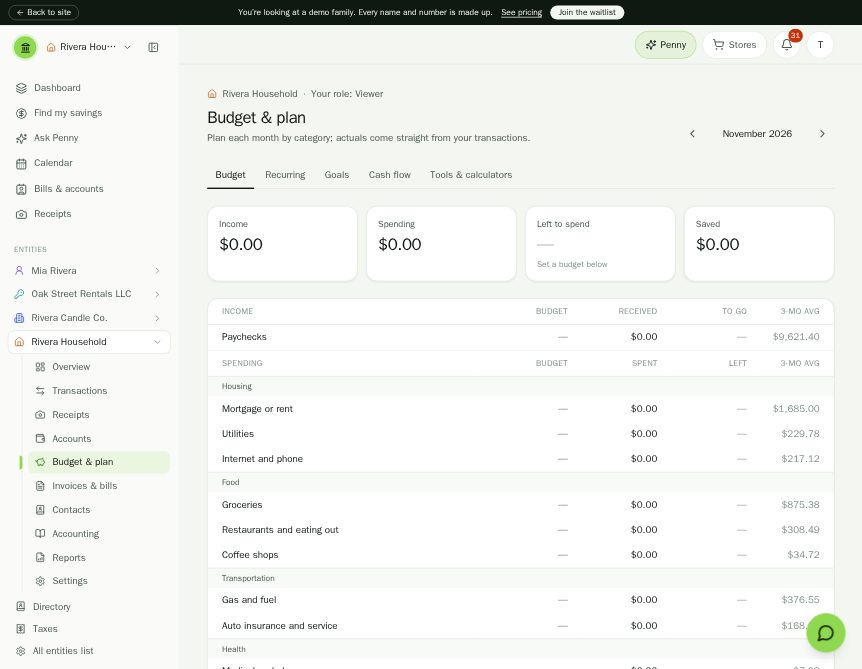
Set up your first budget
- 1Open your household → Budget & plan → Budget and pick the month at the top.
- 2Fill it quickly from your average over the last three months, then adjust any line to match the style you chose.
- 3Each row shows budgeted, actual and what’s left. Over-budget rows turn red, and you can be alerted.
Quick quiz
3 questions
Go deeper
- I Will Teach You to Be Rich, Ramit SethiAutomate the important things, then spend freely on what you love.
- The Total Money Makeover, Dave RamseyA detailed, every-dollar approach to budgeting and debt.
Track this automatically in Stackyard
Connect your accounts once and Penny watches for this every time your banks sync.
For education only; not financial, tax or legal advice. Store rules, rates and tax figures change; check the source before you act.