Lesson 11.2
How income tax works
Brackets, deductions and credits. 5 min read
The big ideaOnly the dollars above a bracket line pay the higher rate, so a raise never pushes all your income into a higher bracket.
Federal income tax follows the same steps for everyone. Start with your income, subtract deductions, apply the bracket rates, then subtract credits.
Step 1: deductions lower your taxable income
Most families take the standard deduction, a set amount you don’t need receipts for. For 2026 it’s $16,100 for single filers, $32,200 for married couples filing jointly and $24,150 for heads of household (checked November 2026 on irs.gov). Others itemize, which means adding up mortgage interest, state taxes and gifts to charity instead.
Step 2: brackets tax each slice at its own rate
Income is taxed in slices. Here’s 2026 for a married couple filing jointly. The first $24,800 of taxable income is taxed at 10%. The part from $24,800 to $100,800 is taxed at 12%, and the part from $100,800 to $211,400 at 22%. Higher slices have higher rates.
Example · The Rivera family
To keep it simple, say the Riveras’ only income is $110,000 in wages, filing jointly in 2026. After the $32,200 standard deduction, taxable income is $77,800. Tax: 10% of $24,800 ($2,480) plus 12% of the next $53,000 ($6,360) = $8,840. That’s about 8% of their income, even though their top bracket is 12%.
Step 3: credits cut the tax itself
A deduction lowers the income you’re taxed on. A credit lowers the tax bill dollar for dollar. For the Riveras in the 12% bracket, a $1,000 deduction saves $120, while a $1,000 credit saves the full $1,000. The child tax credit is a common example.
Most states have their own income tax with their own rules, and a few have none. Check your state too.
Key notes
- Income minus deductions is taxable income.
- For 2026, the standard deduction is $16,100 single, $32,200 married filing jointly, $24,150 head of household.
- Brackets tax each slice of income at its own rate. A raise never lowers your take-home pay because of brackets.
- A credit cuts the tax itself; a deduction only cuts taxable income.
A steward’s view
Knowing how taxes work helps you pay what you owe, and no more.
Do it in the app
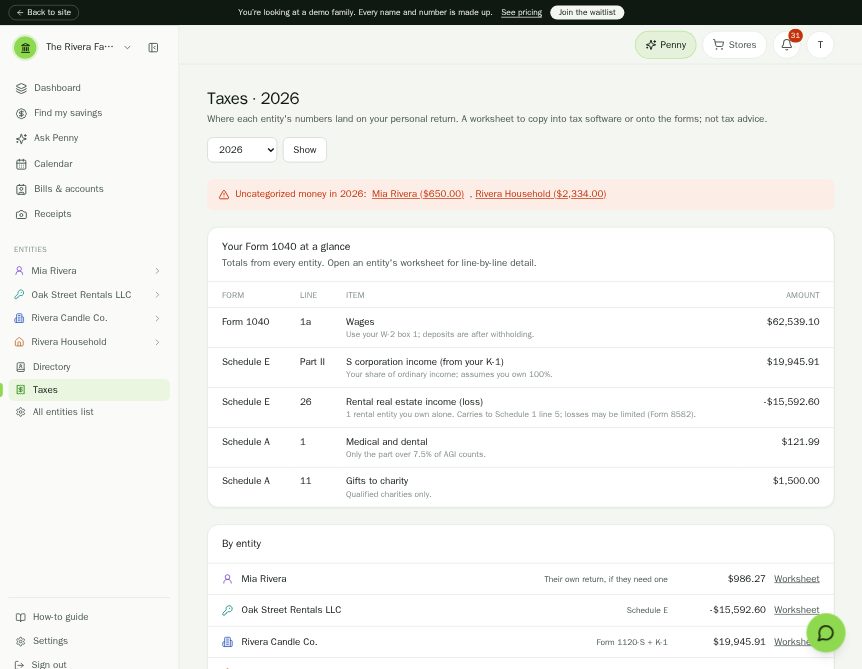
See where each entity lands on your return
- 1Open Taxes in the sidebar: totals from every entity, grouped by form and line (Schedule C, Schedule E and so on).
- 2Fix any “categories not assigned to a tax line” so they count.
- 3Open an entity’s worksheet for line-by-line detail, then copy it into tax software or hand it to your CPA.
Quick quiz
3 questions
Go deeper
- IRS Publication 17: Your Federal Income TaxThe IRS’s own plain guide to filing a personal return.
- Personal Finance For Dummies, Eric TysonClear chapters on taxes, deductions and keeping more of what you earn.
Track this automatically in Stackyard
Connect your accounts once and Penny watches for this every time your banks sync.
For education only; not financial, tax or legal advice. Store rules, rates and tax figures change; check the source before you act.