Lesson 10.4
Quarterly taxes
Self-employment tax and paying estimated tax four times a year. 5 min read
The big ideaNo one withholds tax from your business income, so you pay it yourself, four times a year.
At a job, your employer takes tax out of every paycheck. When you work for yourself, nobody does. You owe income tax on your profit, plus self-employment tax.
Self-employment tax, simply
Self-employment tax is Social Security and Medicare for people who work for themselves. Employees and employers split it. You’re both, so you pay both halves: 15.3% in all (12.4% Social Security, 2.9% Medicare).
- It applies once your net earnings from self-employment are $400 or more for the year.
- It’s figured on 92.35% of your profit, not 100%.
- You deduct the employer half when you figure your income tax.
- For 2026, the Social Security part stops after $184,500 of combined wages and self-employment earnings. Medicare has no cap.
Example · Rivera Candle Co.
The candle shop expects a $20,000 profit in 2026. Self-employment tax is figured on 92.35% of that, $18,470. At 15.3%, that’s $2,825.91. Income tax comes on top, so Maria’s tax bucket needs to cover both.
The four due dates for 2026 (checked November 2026)
- April 15, 2026
- June 15, 2026
- September 15, 2026
- January 15, 2027
You generally need to pay estimated tax if you expect to owe $1,000 or more when you file. To generally avoid an underpayment penalty, pay on time at least 90% of this year’s tax, or 100% of last year’s. That 100% becomes 110% if last year’s AGI (adjusted gross income) was over $150,000, or $75,000 if married filing separately.
If you also have a job, you can raise the tax withheld from your paycheck with a new W-4 instead of, or as well as, paying quarterly. Many states have their own estimated payments too.
Key notes
- Self-employment tax is 15.3% for Social Security and Medicare, on 92.35% of your profit.
- For 2026, payments are due April 15, June 15 and September 15, 2026, and January 15, 2027.
- Paying 90% of this year’s tax or 100% of last year’s (110% for higher incomes) on time generally avoids a penalty.
- Save for taxes as money comes in, not when the due date arrives.
A steward’s view
Paying taxes on time is part of running an honest business, and it keeps April from becoming a crisis.
Do it in the app
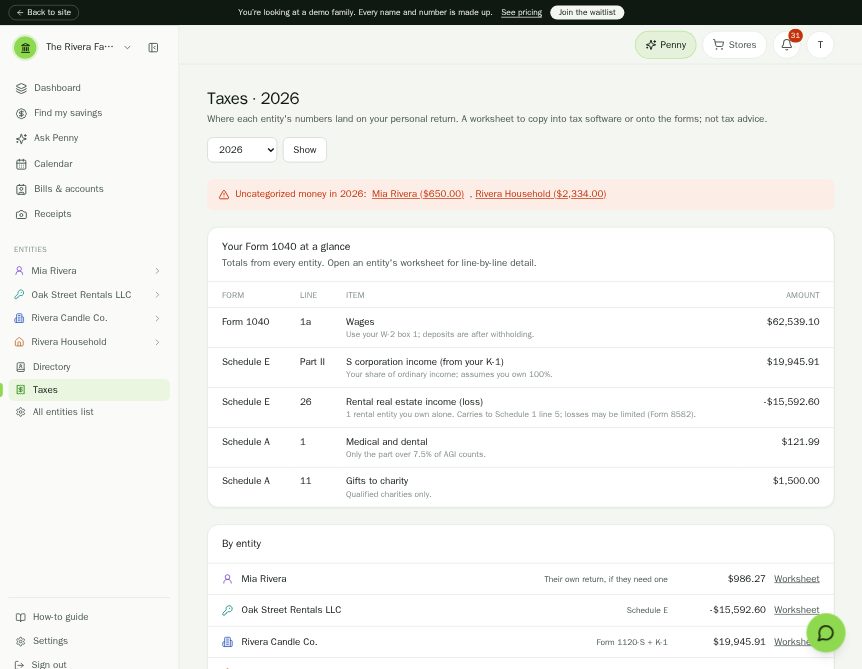
See what your business adds to your taxes
- 1Open Taxes in the sidebar. Totals from every entity are grouped by form and line, so your business profit shows on Schedule C.
- 2Fix any “categories not assigned to a tax line” so every sale and cost counts.
- 3Open the business’s worksheet for line-by-line detail to share with your CPA or tax software. It’s a worksheet, not tax advice.
Quick quiz
3 questions
Go deeper
- IRS Form 1040-ES (2026)The worksheet for figuring estimated tax, with the due dates and payment options.
- IRS Publication 505The full rules on withholding, estimated tax and the underpayment penalty.
Track this automatically in Stackyard
Connect your accounts once and Penny watches for this every time your banks sync.
For education only; not financial, tax or legal advice. Store rules, rates and tax figures change; check the source before you act.